Monthly Archives: June 2011

Radish, but not as we know it

First radish pods today.

I’ve never been much of a fan of radish (Raphanus sativa). The taste is so-so, you can only use so much of it in a dish due to its hotness and if you take your eye off it for two seconds it becomes hollow, woody and slug-chewed. However, when a friend gave me a few seeds of a variety described as having roots of a ‘uniquely lurid blue’, how could I resist?

The colour, a less-than-lurid brown, was a great disappointment and the plants ended up being left, unharvested, in the ground. As it turned out, that was when the fun started. Being a permanent experimenter, I started trying other parts of the plant. The leaves, fried a few at a time with a little salt, turn into brown crispy things that are so moreish that they rarely make it from the frying pan to the plate before being scoffed.

Radish seed pods are meant to be edible: these ones turned out to be very variable, ranging from woody, hairy, unpleasant tasting things to beautiful , smooth, succulent little vegetables with just enough bite to make them interesting. A few years of pulling up the undesirable ones and letting the others seed have left a strain that is reliably worth picking in quantity and freezing for use in stir fries, stews and pasta sauces. I have read that they are also worth pickling but haven’t tried it yet.

The strain has now found a place in the forest garden as one of the small number of annual species able to sustain itself by self-seeding in a perennial set-up. What has struck me the most about it is how quickly unnatural selection can work in some cases.

Sweet cicely

I’ve been doing a little experimenting with sweet cicely (Myrrhis odorata) lately. It’s a plant with a lot of pluses. All parts of the plant have a strong aniseed flavour. It’s native, good for wildlife, tasty, vigorous, perennial and shade tolerant. The big downside for me is that it isn’t very productive. The leaves are available all growing season; they can be used as a seasoning and are traditionally cooked with rhubarb to reduce its acidity, but I don’t find them that great and they are far too hairy for salad use. The young seeds are great, but as they get older they become tough and fibrous. The root is woody and rather unpalatable. How to get more out of sweet cicely?

Image by Rasbak on Wikimedia Commons

My first try was to cut a plant down after picking all the young seeds, in the hope of getting it to flower again. That didn’t work, but at the Wild Harvests Gathering Andy from Fresh Direct told me that if you cut a plant down when it first flowers then it will flower again later, so if you have more than one plant you can spread the season out. Another thing I got to try at the Gathering was juiced sweet cicely, which has quite an oomph and is probably best used as a mixer.

Next up was storing. Seeds picked while young go black like the mature ones, but if put in water they will rehydrate with all their flavour and some of their tenderness. They also freeze well.

I also wondered if the first year root might be nicer than the mature one, so I dug up one of the many seedlings that come up in the wild part of the forest garden. It was straight and clean and peeled like a parsnip. After a few minutes cooking it was tender and tasty. Possibly too strong to want a plateful, but it would go great in curries and winter stews. You could keep an adult plant for seed and grow young plants like an annual (which would give an interesting opportunity for some plant breeding), or just dig up the seedlings that it produces so enthusiastically. I’ll keep you posted on how long into the season the roots stay tender.

Stop that plant!

ground elder

One thing you have to consider with planting a forest garden is how the plants you put in are going to spread, either by seed or by roots and runners. No matter how much you like a plant, you are unlikely to want it across your entire site. Strategies that stop your own plants from becoming weeds will also help stop out-and-out weeds like creeping buttercup which can otherwise spread through a perennial setup very quickly.

A lot of forest garden species just quietly sit where you put them, getting a little bigger every year and patiently waiting for you to divide them. These are the swots of the class. At the other end there are plants so unruly that it’s a bad idea to even put them in. Nettle is one of these. No matter how many uses this plant has and how good for wildlife it is, it’s just not getting in my garden again. It spreads by aggressive, persistent runners and seeds itself all over the place. Then, when you try to weed, it attacks you. This is one plant I will stick to foraging [2017 update: this turned out not to be true 🙂 ].

In between, there are plants that will try to spread, but that can be contained with a bit of care. There are various strategies for this. Vigorous spreaders like mint and dittander are best planted in a pot sunk into the soil, or you will quickly have far more of them than you are ever likely to need. It’s also a good idea to divide your plot up into beds using weed barriers. I have a good network of woodchip paths which are there as much as easily hoe-able barriers as for access. Sometimes a row of a particularly vigorous but non-spreading plant, like Russian comfrey, can make an effective barrier. Plants that die down early can leave a hoe-able strip behind them: I have a row of wild garlic that I use this way.

Once you have beds, you can match plants by their spreadability. Put all the well-behaved ones together, then corral the adventurous ones in a well-barriered ‘thug bed’ and let them sort it out between themselves. It’s useful to observe in nature which plants manage to come to an equilibrium with each other: this spring I saw a mixed swathe of nettles, ground elder, wild garlic and lesser celandine – all useful edible plants with marked imperialist tendencies – in the shade of a beech tree.

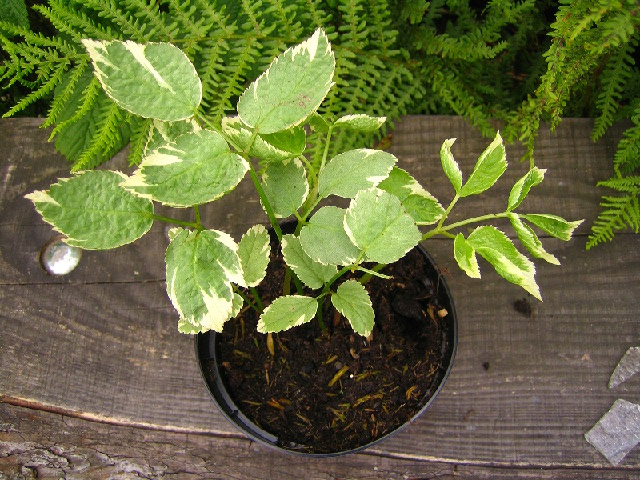
With this in mind, I have finally allowed Margaret Lear of Plants With Purpose to persuade me to try ground elder (Aegopodium podagraria) in my garden. I like ground elder, at least since I discovered that the way to eat it is to pick the only-just-emerged leaves and fry them in olive oil, but I’ve never wanted it in my garden. Margaret’s variety is variegated, so it should be a little less vigorous – and also easier to hunt down if I ever take against it. [You can find out how I got on with ground elder here.]

Snails!


Out in the rain taking a few cuttings, I took the opportunity today to scoop up a few snails that were out for a wander. Slugs and snails aren’t a huge problem in the forest garden, certainly compared to the annual patch, but I like to try to keep the numbers down a bit. I don’t usually go out in the rain hunting them: my preferred strategy is ‘I know where you live’. I have ideal homes for snails dotted round the garden: a flat rock or slate resting up against another one with a small gap is perfect. I occasionally make a circuit of these and put the harvest on the bird table, which is set up with a few rocks and a handful of weeds so that it isn’t too uncomfortable for the snails while they wait for the thrushes to come. I don’t honestly know whether the thrushes do come – I’ve never seen it – and perhaps all I do is keep the snails busy for a bit while they climb back down, but it seems to work.

A Buddhist friend once protested that this treatment smacked of ‘extraordinary rendition’, but I had become concerned with the amount of nutrients I was taking out of the allotment by removing bucket-loads of molluscs. This way there is a chance that they get cycled around again within the garden.

It’s also very important to keep up a good population of animals that eat slugs, snails and their eggs in the forest garden, so a pond for frogs, a habitat pile for hedgehogs and rocks and boards about the place for beetles are essential parts of my mollusc-control strategy.

Last year we tried a more full-on approach to the problem and decided that if the allotment was determined to produce snails then it was rude not to try eating them. The biggest and healthiest were selected from the snail homes and fed on leaves for a few days to purge them of any grit or poisonous plants that might have been in their guts. They were dropped into boiling water to kill them as fast as possible: once cooked they were scooped out of the shells and prepared various ways – frittering and in a strong tomato sauce seemed to be the best. It certainly added some useful protein to our almost vegetarian diet, but it was impossible to get around the fact that they tasted rather, well, snaily, so this year the birds are getting them again.

The one time when the slugs and snails can be a pest in the forest garden is when getting new, small plants established and here I thoroughly recommend using slug collars. They really work, even in the rain, they are simple and they last forever.

Foraging in the allotment

The boundary between forest gardening and foraging is a fuzzy one. Picking in a forest garden feels more like a condensed foraging experience than convential harvesting. Perhaps because you are usually picking from the plant without uprooting it. Perhaps because the average harvest run usually takes in a dozen or so species rather than just one or two. Perhaps because of the seasonality of it or because a forest garden just feels so much more like the wild.
On Wednesday I’m off to the Scottish Wild Harvests Association Gathering at Cairn O’Mohr Winery (you have to say it aloud) to explore the subject further – and possibly drink some elderberry wine 🙂

Peach-leaved bellflower/ salad bluebell

Campanula persicifolia

Yay! My favourite salad flower started producing today. It’s peach-leaved bellflower (Campanula persicifolia), but since that’s a bit of a mouthful we usually call it salad bluebell. (Campanulas are called bluebells in Scotland. The plant that they call bluebell in England is pretty poisonous. This is why Latin names are so good!) It has a mild taste and the flowers are large and produced in abundance between now and the first frost. This means that it can be used as a bulk salad ingredient, so from this time of year our salads generally turn blue.

The whole Campanula genus is edible and further south I’m told that C versicolor tastes nicest, but persicifolia is thoroughly hardy and thrives in Aberdeen, which is what I look for in a plant.

Photo from Wikipedia Commons, with thanks to Pixeltoo.

Welsh onion

welsh onion

welsh onion

It’s practically impossible to get a photo of welsh onion flowers without a bee getting in on the act. It’s one of the big pluses of forest gardening that a plant gets to go through all stages of its life cycle, with little lost compared to annual gardening except periods of bare earth and weeding. These stages are generally the ones that support more wildlife and the forest garden is full of bees, beetles and birds.

Welsh onion (Allium fistulosum) is nothing to do with Wales: the name comes from wellisc meaning ‘foreign’ in Old English. It is also known as Japanese bunching onion, which is equally a misnomer as it’s thought to come from China or Siberia. Whatever it says on its passport though, it grows well in Britain and is a very useful allium.

There are two ways of harvesting it. It grows as a clump which slowly gets bigger, so you can lift and divide it, replanting half and using the other half as spring onions or scallions. This is how it’s mostly used in Asian and Jamaican cuisine. Alternatively, you can just pull green leaves off it almost all year round, except when it is flowering or in a hard winter when it dies down. Some people like the leaves chopped into salads but I find the flavour quite strong and only use it for cooking.

Welsh onions put a good deal of energy into producing quite chunky flowers, but this isn’t wasted as you can use the flower heads too. Pick them while they are still young and green and nip out the centre. You will have a shower of tiny flowers that you can use anywhere you would use chopped onion. (But leave a few for the bees.)

Broad beans

crimson-flowered broad bean

I like to have a few patches of legumes scattered through the perennial crops in the forest garden, as they have bacteria-filled nodules on their roots that fix nitrogen direct from the atmosphere, so they feed the system at the same time as producing a crop. I’ve got peas (Pisum sativum) and the perennial pea Lathyrus latifolius planted with the raspberries – both as experiments – this year and a few native vetches scattered around. Broad beans (Vicia faba) are so productive and reliable that you really can’t go wrong with them. One very useful discovery this year is that the leaves as well as the beans are edible and nice.

Fruit thinning

I bit the bullet and started thinning out the apples and Victoria plums today. Fruit trees sometimes set more fruit than they really have the resources to ripen, leading to smaller individual fruit and exhausted trees, so while the fruits are still small it can be a good idea to thin them out a bit, which also gives a chance to remove ones which look diseased or deformed before the tree has invested much in them. The Vicky plum in particular has just been wildly over-ambitious this year, setting enough fruit to break the tree, so I took almost half of them off. I always leave this task a bit late as it just feels wrong to be taking unripe fruit off, but my experience is that it really does help.

Yellow day lily

Yellow day lily

Yellow day lily

The yellow day lilies (Hemerocallis lilioasphodelus) are in full bloom at the moment. The day lilies (Hemerocallis) are a very useful group. Some have edible tubers but the flowers are the stars. They go well (and pretty spectacularly) in salads, but I like the taste best in stir fries or soups. The Chinese use them to thicken soups and stews: you can see big bags of ‘lily flowers’ in Chinese supermarkets (but beware, some true lilies are poisonous – the perils of common names). They keep this property when dried, which they do pretty well themselves on the plant. Once dry they keep forever.

They yellow day lilies are always the first into flower with me: if you grow a range of species and varieties you can have fresh flowers for two or three months.